The Ocean Is Basically Playing With Light
Have you ever looked at the ocean and wondered, “Wait a minute… isn’t water supposed to be clear?” Grab a beach towel and your inner scientist, because the answer is hiding in the way light behaves underwater.
If you fill a glass with tap water, it looks completely clear. You could probably stare straight through it and wonder why you are suddenly conducting a very boring science experiment. But put that same water into a gigantic ocean, and suddenly it becomes a beautiful shade of blue. So, what happened?
Sunlight Has More Colors Than You Think
Sunlight may look white, but it is actually made up of many different colors. Think of it as a rainbow wearing a disguise. When sunlight enters the ocean, the water molecules interact with the light.
Here is where things get interesting: water absorbs some colors of light more easily than others. Reds, oranges, and yellows are absorbed relatively quickly as sunlight travels deeper into the water. Blue light, however, can travel farther because it is absorbed less strongly.
Why Isn’t Every Ocean the Same Shade of Blue?
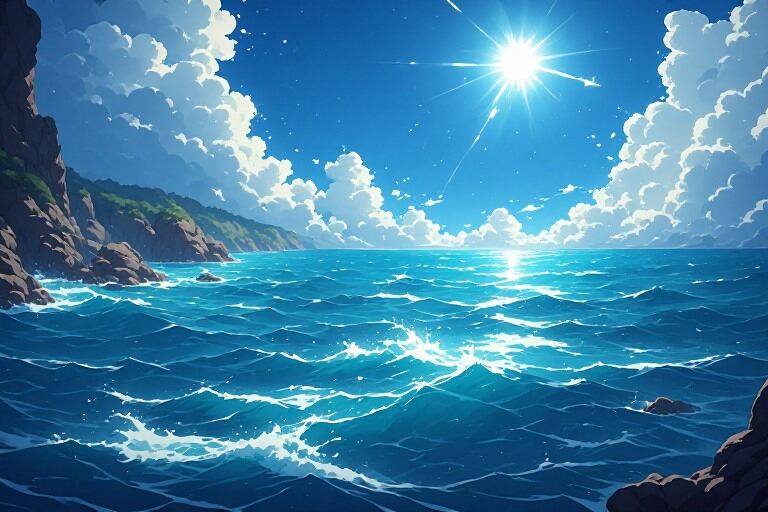
Eventually, more blue light gets scattered back toward our eyes, making the ocean appear blue. But wait—why isn’t the ocean always the same blue? Good question, Captain Curiosity.
The color can change depending on what is floating or living in the water. Tiny organisms called phytoplankton can give seawater a greener appearance. Sand, mud, and other particles can also affect the color. And when the sky is bright blue, some of that color can be reflected from the ocean’s surface, adding to the effect.
From Deep Blue to Tropical Turquoise
That is also why the ocean can look turquoise near tropical beaches. Shallow, clear water over pale sand allows more light to bounce around and reach your eyes. The result can be that gorgeous bright turquoise color that makes people immediately want to take approximately 47 beach photos.
So, technically, the ocean isn’t blue because water itself is naturally blue like a giant bottle of sports drink. It is blue because of how water absorbs and scatters different wavelengths of sunlight, combined with what is happening above and beneath the surface.
In other words, the ocean is perfectly clear when you have a tiny glass of it but give it an enormous amount of water, sunlight, depth, and a little physics, and suddenly it gets a dramatic blue makeover. Science really does know how to accessorize.