
Long before sugar derived from sugarcane or beets became a staple of daily life, honey served as a fundamental element of existence in ancient Greece. It wove together nutrition, mythology, medicine, commerce, and ritual practice—a legacy that continues to shape Greek culinary culture to this day.
In a world without refined sugar, honey was the primary sweetener. It was added to beverages, used in cooking, or enjoyed on its own, and was also highly valued as a nutritious food source. Its economic significance was also clear: even in antiquity, Greek honey—most notably the renowned variety from Mount Hymettus near Athens—was a sought-after commodity that was traded over great distances.
Honey holds a special place in mythology. It is said that the infant Zeus, while hiding from his father Cronus in a cave on Crete, was nourished with honey by bees and the nymph Melissa (whose name means “bee”). The god Aristaeus is regarded as the mythical inventor of beekeeping, credited with teaching humanity the art of keeping bees. Furthermore, bees and honey appeared in cultic contexts—as offerings to the gods and the deceased, in libations, and in connection with the concept of “divine food.”
Practical beekeeping developed into an established craft at an early stage. As early as the 6th century BC, Solon of Athens enacted regulations regarding the placement of beehives, which points to a widespread and organized practice. In his *Historia animalium*, Aristotle provided a detailed description of the structure of a bee colony, the division of labor, and the behavior of the insects—observations that remained influential well into the Middle Ages. Archaeological discoveries of ceramic beehives provide physical evidence of these ancient apicultural techniques. In addition to floral nectar, bees also collected honeydew—for instance, from scale insects living on pine trees.
The diversity of Greek flora has produced—and continues to produce—a wide variety of honeys. Thyme honey, often associated with Mount Hymettus or islands such as Crete and Kythera, is particularly renowned for its intense, herbal, and spicy aroma. Other varieties include pine and fir honeys (honeydew honeys), wildflower honey, and types derived from heather or other herbs. Today, some of these hold Protected Designation of Origin (PDO) status, including fir honey from Mount Mainalo, Cretan thyme-pine honey, and Kissouri honey from Euboea.
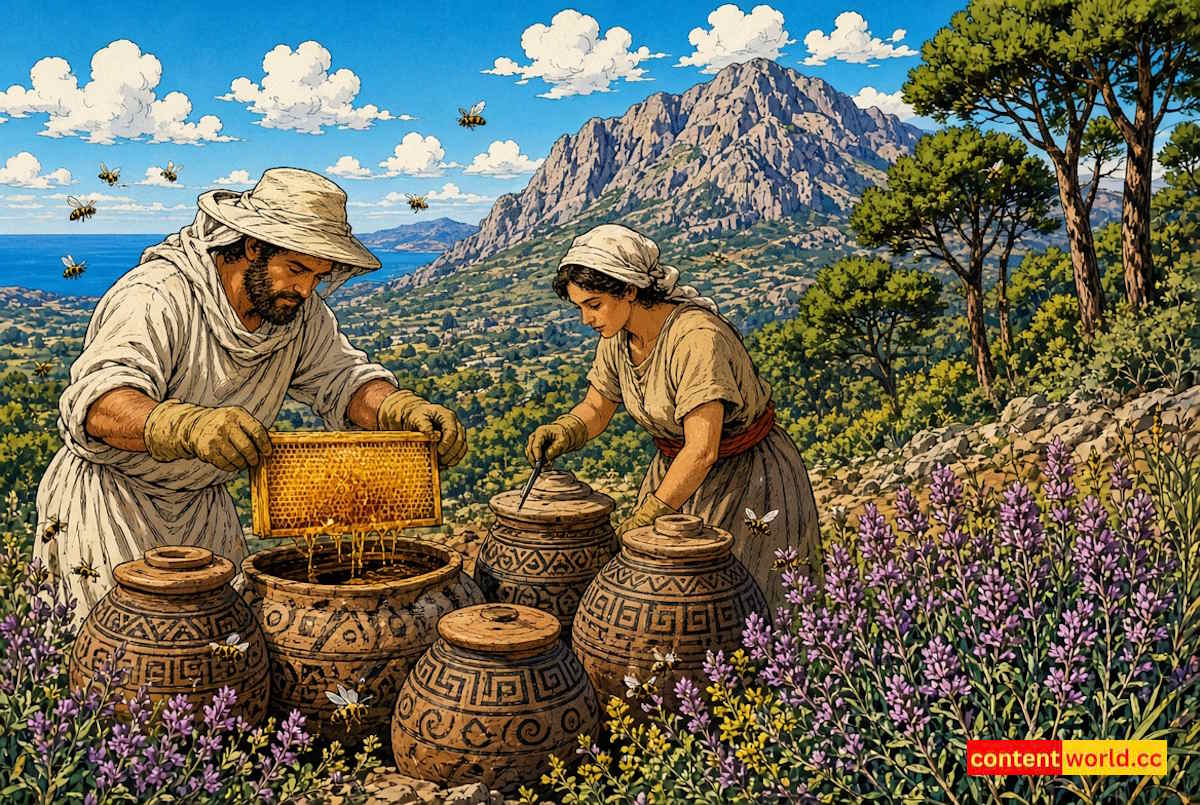
Beyond its simple sweetness, ancient authors valued the specific properties of honey. In the Hippocratic Corpus, it appears in preparations such as *hydromel* (honey water) and *oxymel* (honey mixed with vinegar). It served as a preservative, an aid in wound healing, and an ingredient in various other medicinal and cosmetic applications. It was also commonly used as a component in alcoholic beverages, such as mead.
This tradition continues to this day. Greek beekeepers often practice nomadic beekeeping, following the flowering seasons across the country’s diverse landscapes—from coastal regions and mountain slopes to forests. Honey remains a staple of daily life: drizzled over yogurt with nuts, spread on pastries or bread, incorporated into desserts, or simply enjoyed on its own. The rich botanical diversity and centuries-old practices ensure that Greek honey retains its distinctive character.
From the caves of mythological lore and the observations of ancient philosophers to the breakfast tables of today, Greek honey has traversed a remarkably long and multifaceted journey. A food product obtained by industrious insects from blossoms and trees—one that, to this day, connects culture, cuisine, and the landscape.