Why Do Some Objects Float While Others Sink?
Have you ever wondered why a huge ship can float on water while a tiny coin immediately dives to the bottom? It seems a little unfair. After all, the ship is clearly much heavier than the coin! The secret isn’t simply about weight. It comes down to density, buoyancy, and the amount of water an object displaces.
The Secret Is Density
Density describes how much mass is packed into a certain amount of space. An object that is less dense than the liquid it is placed in can float, while an object that is denser than the liquid will generally sink.
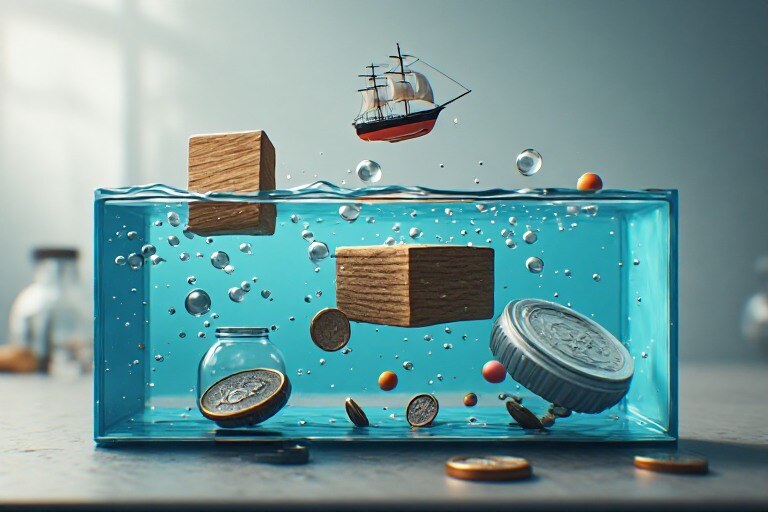
For example, wood is usually less dense than water, which is why a piece of wood can happily sit on the surface. A metal coin is much denser than water, so it heads downward almost immediately.
What Is Buoyancy?
Buoyancy is the upward force that a fluid exerts on an object placed in it. When you get into a swimming pool, the water pushes upward against your body. This is why you don’t simply drop straight to the bottom like a particularly confused rock.
The amount of buoyant force depends partly on how much fluid the object displaces. The more water an object pushes out of the way, the greater the upward buoyant force can be.
Why Do Ships Float?
Here’s where things get interesting. Ships are often made from steel, which is much denser than water. So why don’t they sink?
The answer is their shape. A ship’s hollow structure contains a large amount of air, allowing the entire ship—including the steel—to have an average density lower than water. Its large hull also displaces a significant amount of water, producing enough buoyant force to support the ship.
What Happens When Something Sinks?
If the downward force caused by an object’s weight is greater than the upward buoyant force, the object sinks. Once it reaches the bottom, the surrounding water can no longer provide enough upward force to keep it floating.
A Simple Experiment
You can explore this idea at home with a bowl of water and a few safe household objects. Try a cork, spoon, plastic bottle cap, and coin. Before dropping each item into the water, guess whether it will float or sink.
You might be surprised by some of the results. And if you’re wrong, congratulations you’ve just conducted a perfectly respectable science experiment!
From tiny bubbles to enormous ships, floating and sinking are all about forces and density. Once you understand buoyancy, the behavior of objects in water becomes much less mysterious.